Size a sensor network before you buy it
SNR, limiting magnitude and saturation of real telescope and camera combinations, against the objects you must see — from the ground or from orbit.
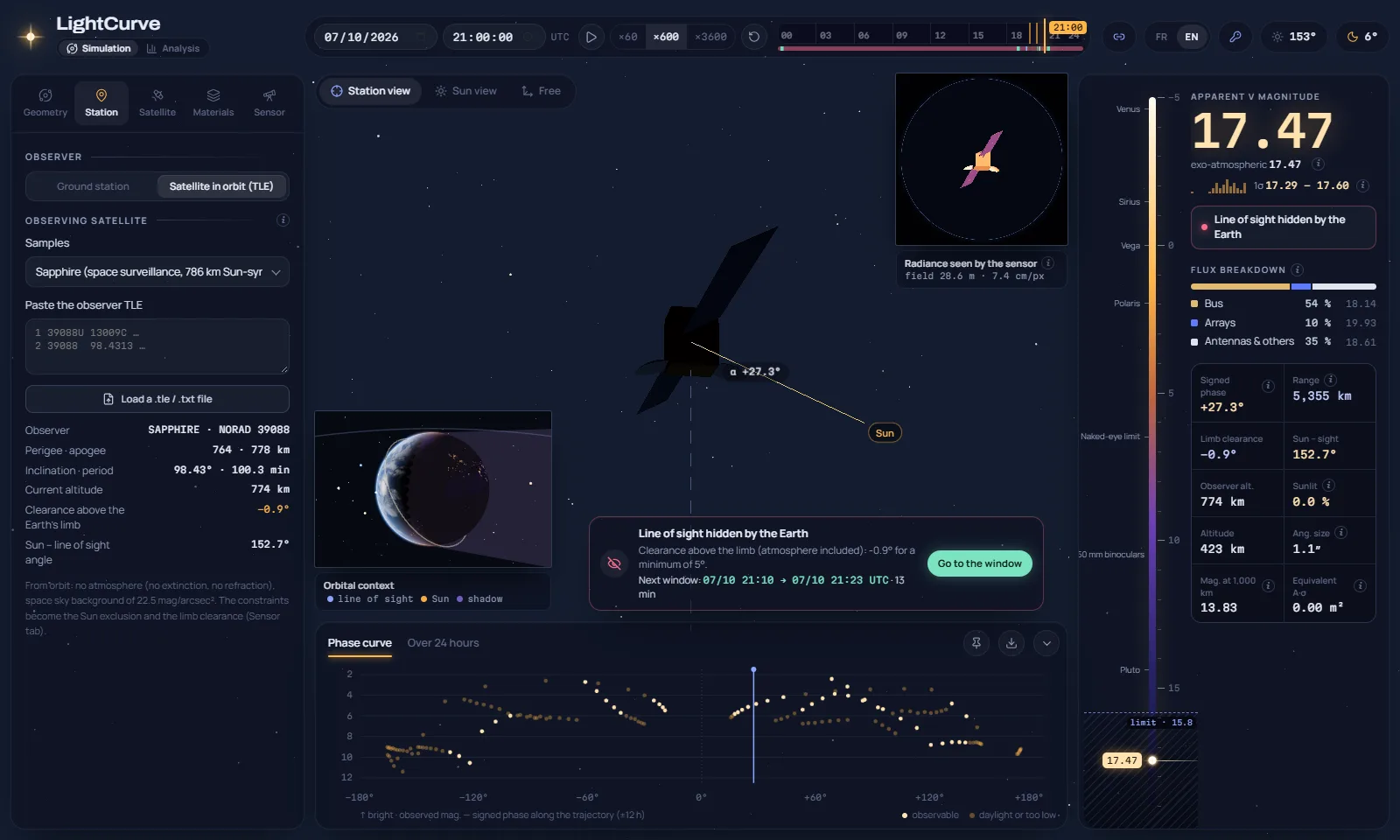
Which telescope, which camera, which site — and will it see the objects that matter at twilight, under a bright Moon, low above the horizon?
Step by step.
- 01
Pick the systems
A catalogue from wide-field astrographs to 1-metre-class telescopes, with CMOS, sCMOS and CCD cameras and their binning. Telescopes and cameras combine freely.
- 02
Set the site and the sky
Atmospheric extinction, sky background, the Moon, refraction near the horizon and sunlight refracted into the Earth’s shadow.
- 03
Compute detectability
SNR, limiting magnitude and saturation for the simulated magnitude, and the observable windows of the coming hours.
- 04
Go to space
Put the sensor on a satellite defined by its TLE: no atmosphere, line of sight hidden by the Earth, Sun-exclusion and Earth-limb constraints.
Deliverables.
- SNR, limiting magnitude and saturation per system
- Observable windows and passes
- Space-based observation geometry
Characterise objects from their light curves
Turn magnitudes into answers: is it stabilised, spinning or tumbling, how fast, how big — and does a physical model explain what your sensors measured?
See the use caseCheck a constellation against the night sky
The magnitude of every design option along real passes, with its uncertainty — to build satellites that astronomers can live with.
See the use caseMake satellite photometry visible
See why a satellite brightens or fades — phase angle, glint, shadow, attitude — live and in 3D, with physics you can check.
See the use caseSee your own objects in LightCurve.
A 30-minute session on your use case: your orbits, your sensors, your measurements if you have them.