Everything between the Sun and your detector.
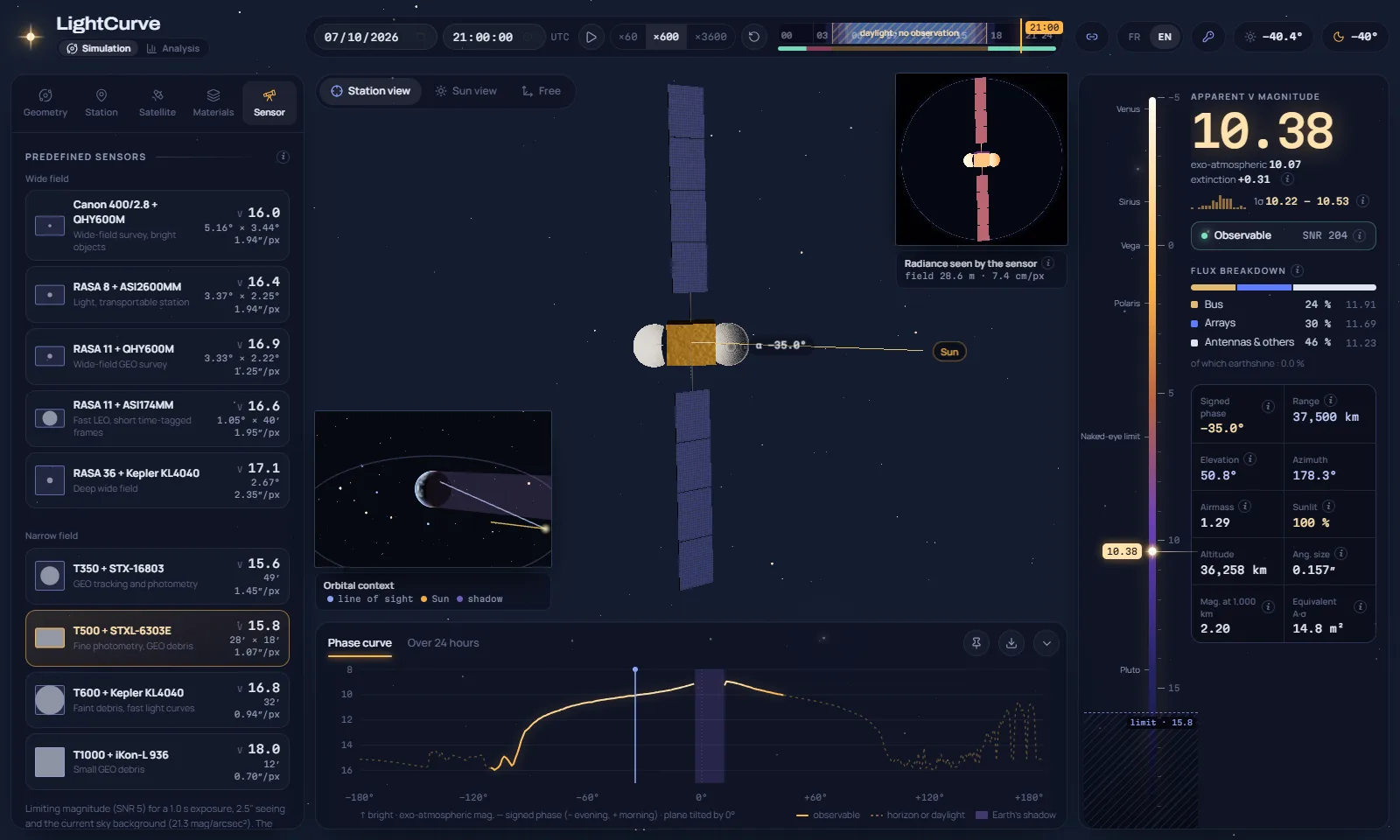
LightCurve models the object, places it in its real geometry, renders the light it reflects on the GPU and turns it into what a sensor records — then compares it with what yours did.
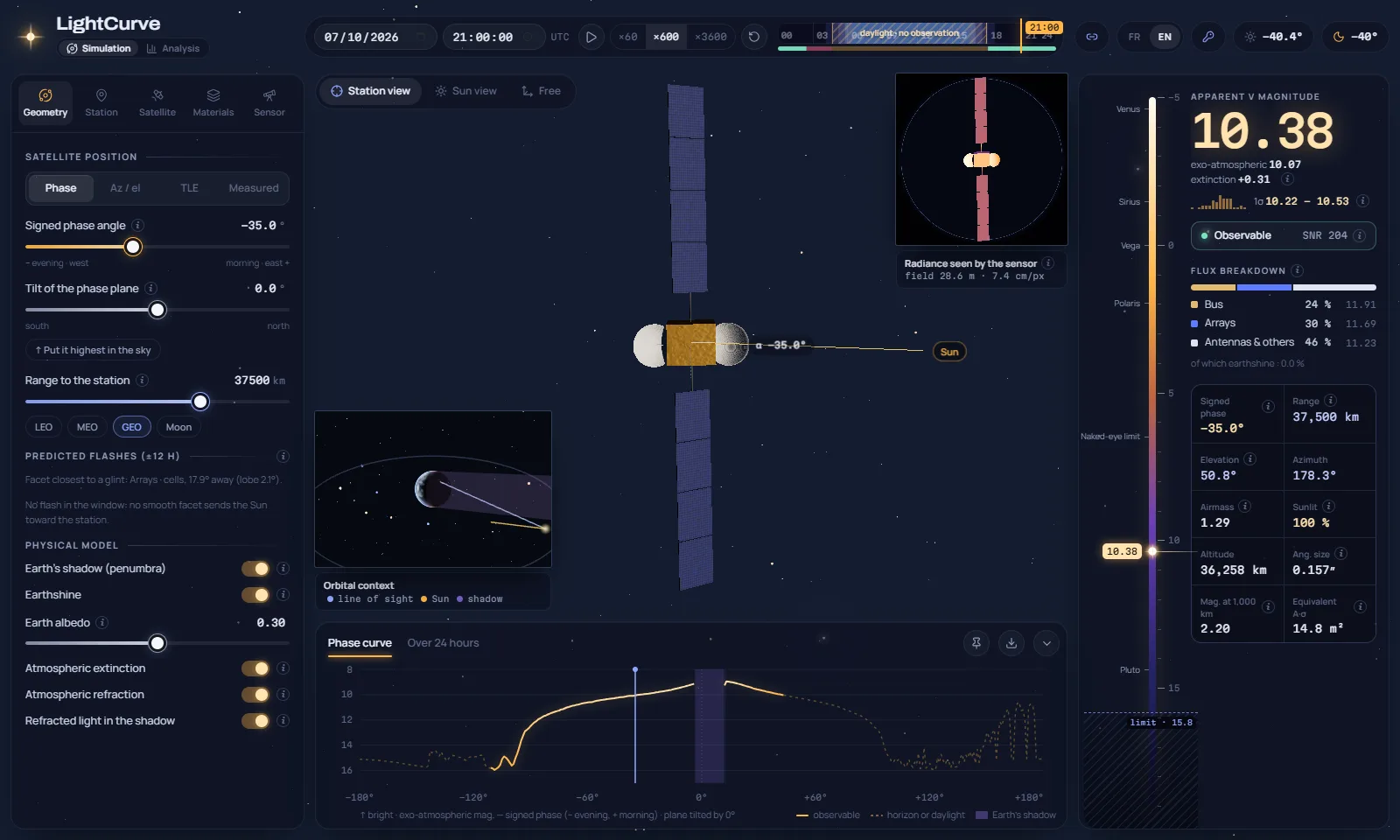
Geometry and orbits
Every way of saying where the object is, from a single angle to a real orbit or a measured track.
- Signed phase angle and range: negative in the evening, positive in the morning
- Azimuth and elevation, or a real orbit from a TLE (SGP4) with the passes of the next 48 hours
- CCSDS OEM ephemerides
- The measured line of sight of a real observation
- Observer on the ground or on a satellite defined by its TLE
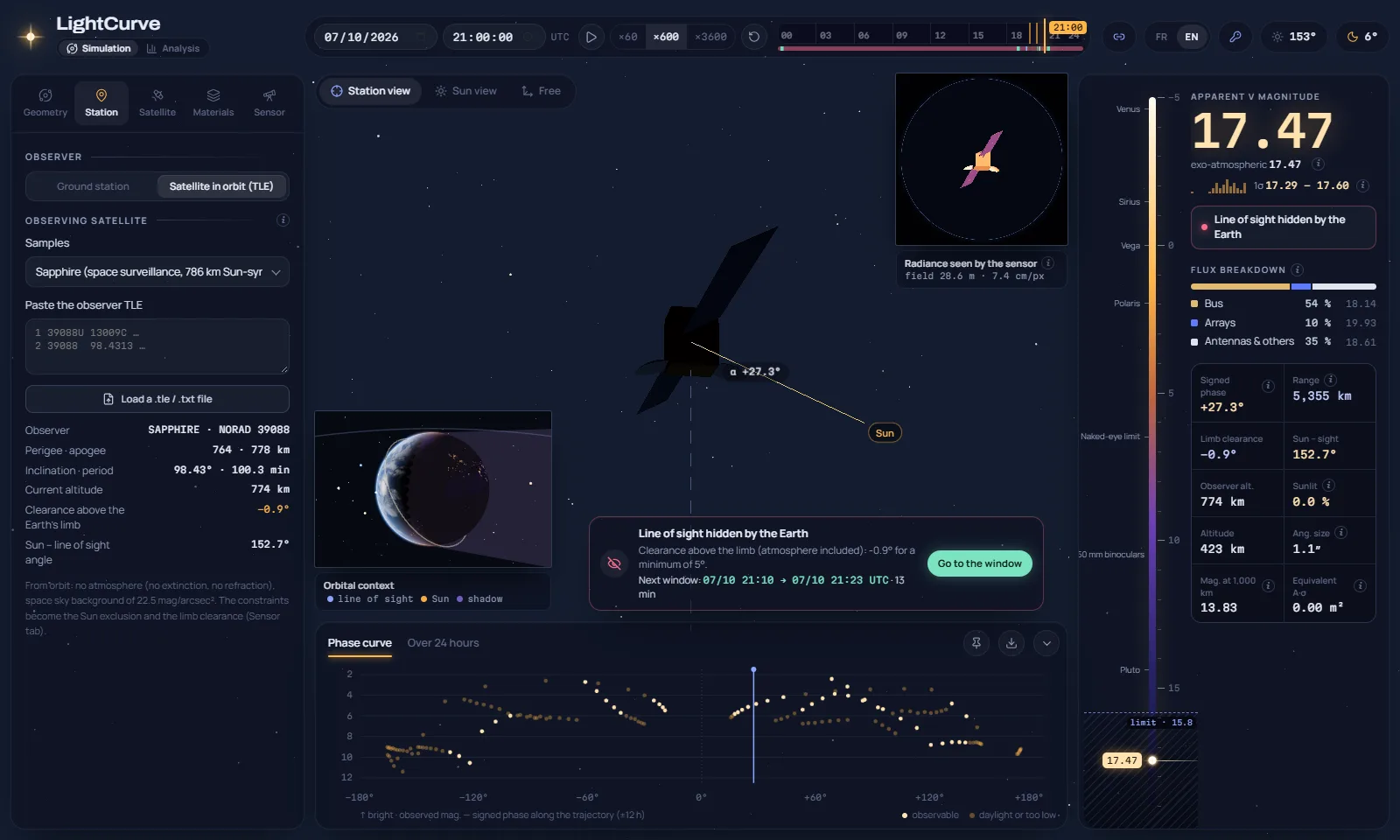
Objects and materials
From a reference model to your own CAD, with surfaces that behave like the real ones.
- 13 parametric models: GEO telecom, broadband-constellation satellites, Earth observation, CubeSat, Hubble, ISS, Tiangong, four upper stages, calibration sphere
- The 20 most frequent shapes of ESA’s DISCOS database, built from their dimensions, or imported from a DISCOS export
- CAD import: glTF / GLB, OBJ, STL, with a material per part
- Material library — MLI, white paint, solar cells, aluminium, OSR mirrors… — or measured BRDF tables from the lab
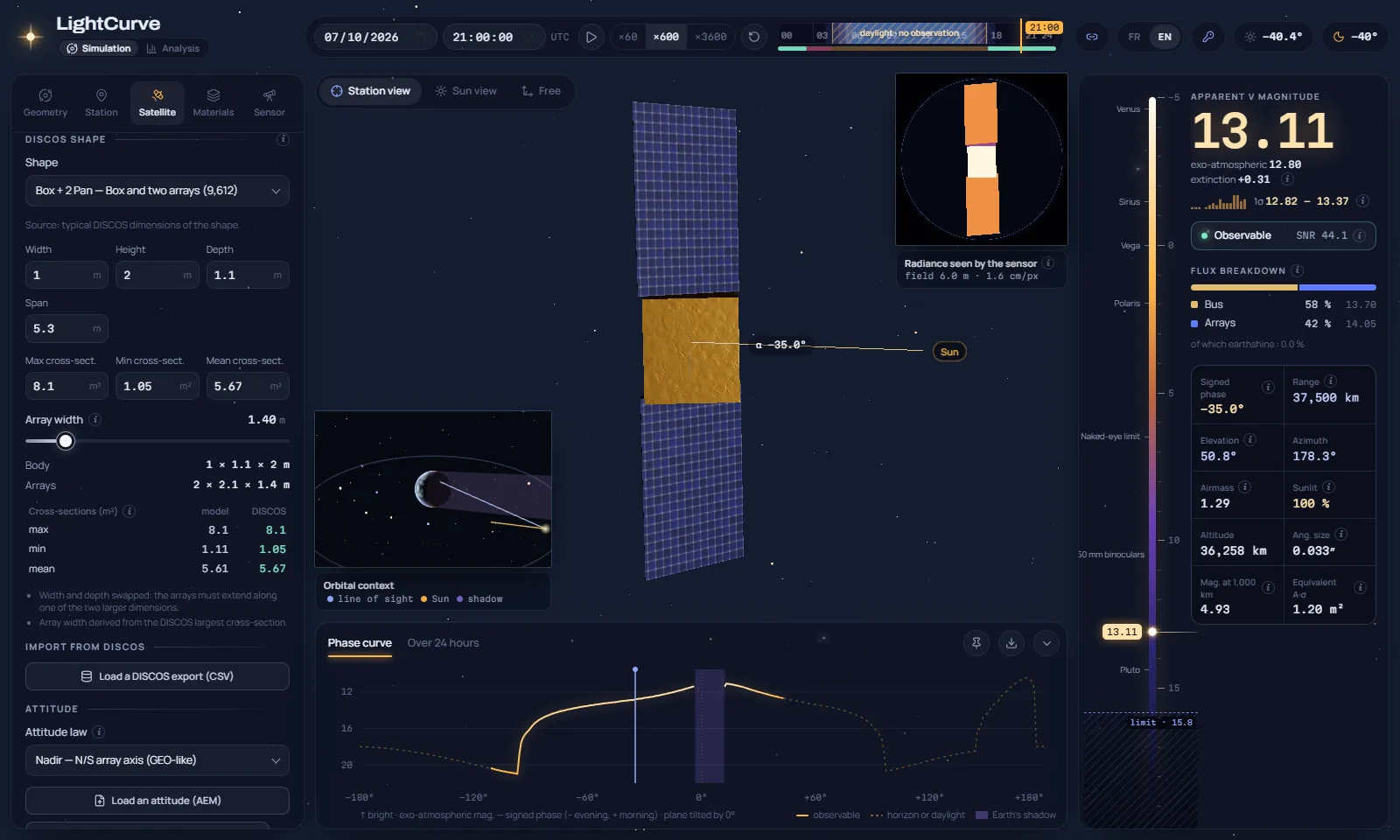
Attitude and rotation
Controlled, spinning or tumbling: the motion that writes the light curve.
- Attitude laws, Sun-tracking arrays, LVLH frame
- CCSDS AEM attitude ephemerides, read and written
- Spin about a fixed axis
- Free tumbling from Euler’s equations: precession and nutation from the inertia tensor
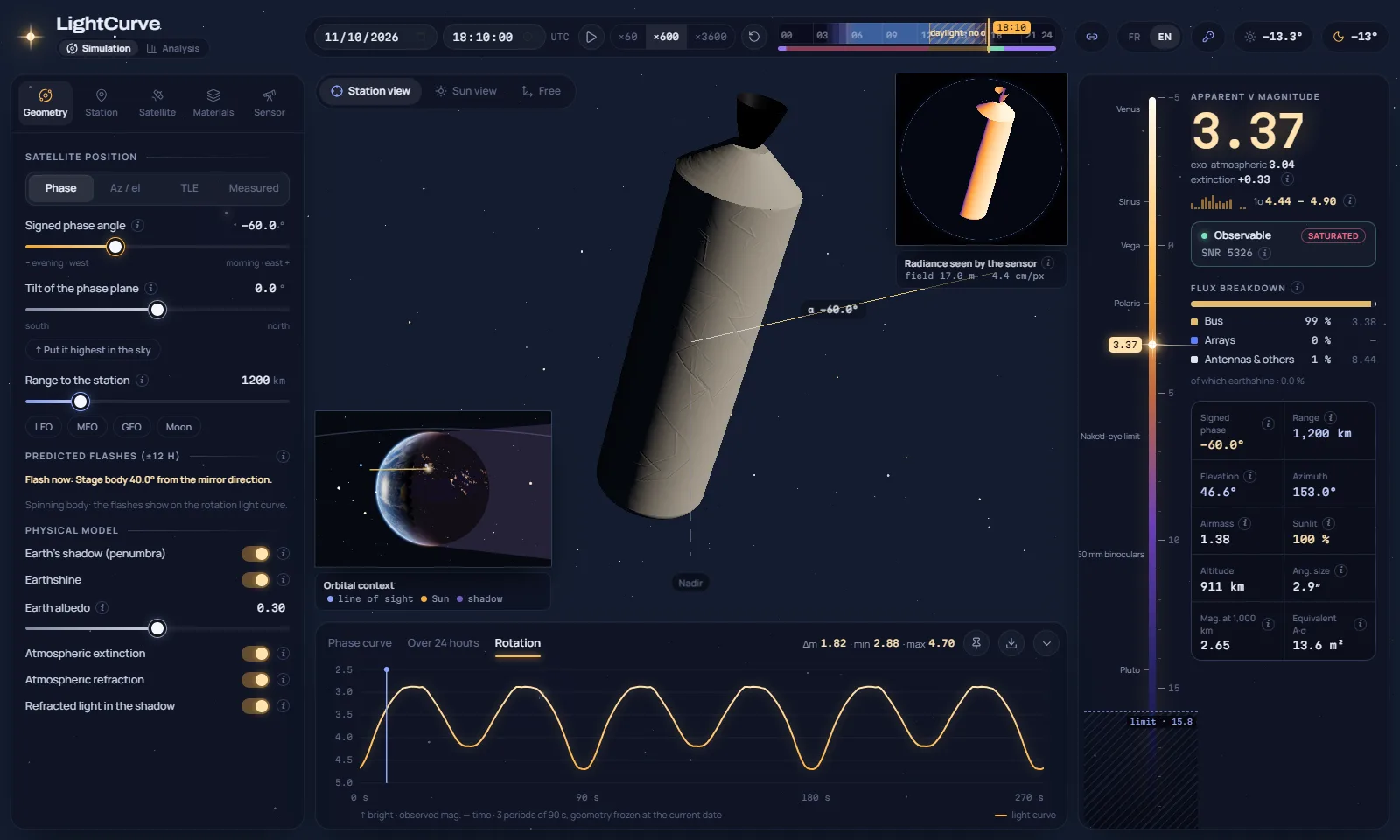
GPU photometric engine
The object is rendered from the observer, and every pixel carries reflected sunlight.
- Orthographic floating-point render from the observer’s point of view
- Lambert + GGX microfacet BRDF, or a measured BRDF table
- Self-shadowing from a Sun-side depth map, earthshine, Earth’s shadow with penumbra, sunlight refracted into the umbra
- A Lambertian sphere within 0.002 mag of the analytic formula up to 120° of phase
Sky and sensor, ground or space
From the magnitude above the atmosphere to what a given camera will record — on a mountain or on a satellite.
- Ground-based or space-based sensors: a site on Earth, or a satellite defined by its TLE
- Photometric bands: V, B, R, I, Gaia G or unfiltered CMOS, with the colour of the Sun and of each material
- Atmospheric extinction, entered or estimated offline from the weather; refraction near the horizon
- Sky background, twilight and moonlight
- Catalogue of telescope and camera systems, CMOS, sCMOS and CCD, with binning
- Signal-to-noise ratio, limiting magnitude and saturation
Curves and predictions
The whole behaviour of an object, not a single number.
- Phase curve, 24-hour curve and spin light curve with its min–max band
- A pinned reference curve to compare designs
- Flashes predicted within ±12 hours: peak magnitude, gain, duration
- Monte-Carlo uncertainty (68 %) and CSV export
Measurements and fitting
Real observations, read back and explained.
- Measurements from CSV or CCSDS TDM; stations from a file or recovered from the angles
- Lomb–Scargle period search and folded light curves
- Attitude-state classification with a confidence index
- Robust automatic fit of materials, attitude and spin, over several nights and stations
Automation and integration
The same engine, without the interface, inside your own chain.
- Batch mode from the command line, JavaScript API
- Labelled synthetic datasets for machine learning
- CCSDS TDM, OEM and AEM, read and written
- Validation runs against published magnitudes
Deployment and data
Online, nothing to install — or on your premises, offline.
- Hosted service: open it in Chrome, Edge, Firefox or Safari, always up to date
- Computed in your browser: your files are processed locally, not uploaded
- On-premises deployment, fully offline, for sensitive environments (add-on)
- Interface in English and French
Speaks the formats you already use.
- Measurements
- CSV · CCSDS TDM
- Stations
- CSV
- Orbits
- TLE · CCSDS OEM
- Attitude
- CCSDS AEM
- 3D models
- glTF / GLB · OBJ · STL
- BRDF
- CSV tables from the lab
- Object metadata
- ESA DISCOS export
- Exports
- CSV · TDM · OEM · AEM
Online, or on your premises.
- Hosted service: a recent Chrome, Edge, Firefox or Safari with hardware acceleration (WebGL 2) is all it takes
- Always up to date: new models, formats and features reach every user without an install
- On-premises deployment for sensitive environments: the same application served from your network, fully offline (add-on)
- Curves, fits and Monte-Carlo draws computed in a background worker: the 3D view stays fluid
- Interface in English and French; every parameter has its explanation
See your own objects in LightCurve.
A 30-minute session on your use case: your orbits, your sensors, your measurements if you have them.