Predict, then explain, the brightness of your satellite
From design review to anomaly investigation: how bright your spacecraft looks, where its glints come from, and what a change in its light curve means.
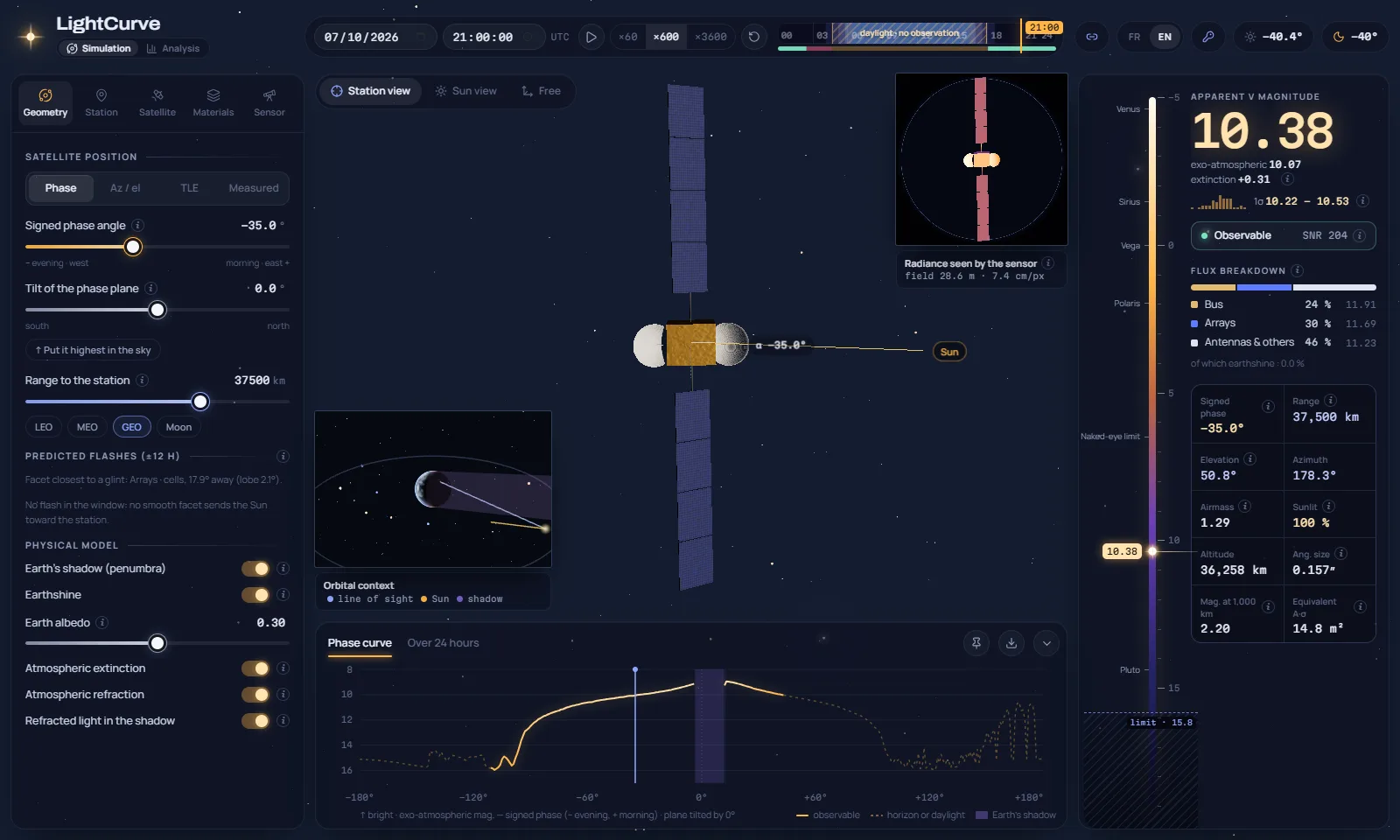
Brightness is a design parameter — for optical tracking, for discretion, for the night sky. Once in orbit, it is also one of the few independent views of what your spacecraft is actually doing.
Step by step.
- 01
Build it
Parametric models, DISCOS shapes or your own CAD (glTF, OBJ, STL). Materials from gold MLI to OSR mirrors, or measured BRDF tables from the lab.
- 02
Fly it
A real orbit from a TLE or a CCSDS OEM ephemeris; attitude laws, Sun-tracking arrays, or a CCSDS AEM attitude ephemeris.
- 03
See every contribution
Magnitude broken down by material, earthshine, Earth’s shadow and extinction. Flashes predicted within ±12 hours, with peak magnitude, gain and duration.
- 04
Diagnose
Load what ground stations measured, compare, and fit the attitude to the light curve when something looks wrong.
Deliverables.
- Magnitudes along passes and over 24 hours from any site
- Flux breakdown by material
- Flash forecast
- Attitude fitted against real measurements
Check a constellation against the night sky
The magnitude of every design option along real passes, with its uncertainty — to build satellites that astronomers can live with.
See the use caseCharacterise objects from their light curves
Turn magnitudes into answers: is it stabilised, spinning or tumbling, how fast, how big — and does a physical model explain what your sensors measured?
See the use caseSize a sensor network before you buy it
SNR, limiting magnitude and saturation of real telescope and camera combinations, against the objects you must see — from the ground or from orbit.
See the use caseSee your own objects in LightCurve.
A 30-minute session on your use case: your orbits, your sensors, your measurements if you have them.