Check a constellation against the night sky
The magnitude of every design option along real passes, with its uncertainty — to build satellites that astronomers can live with.
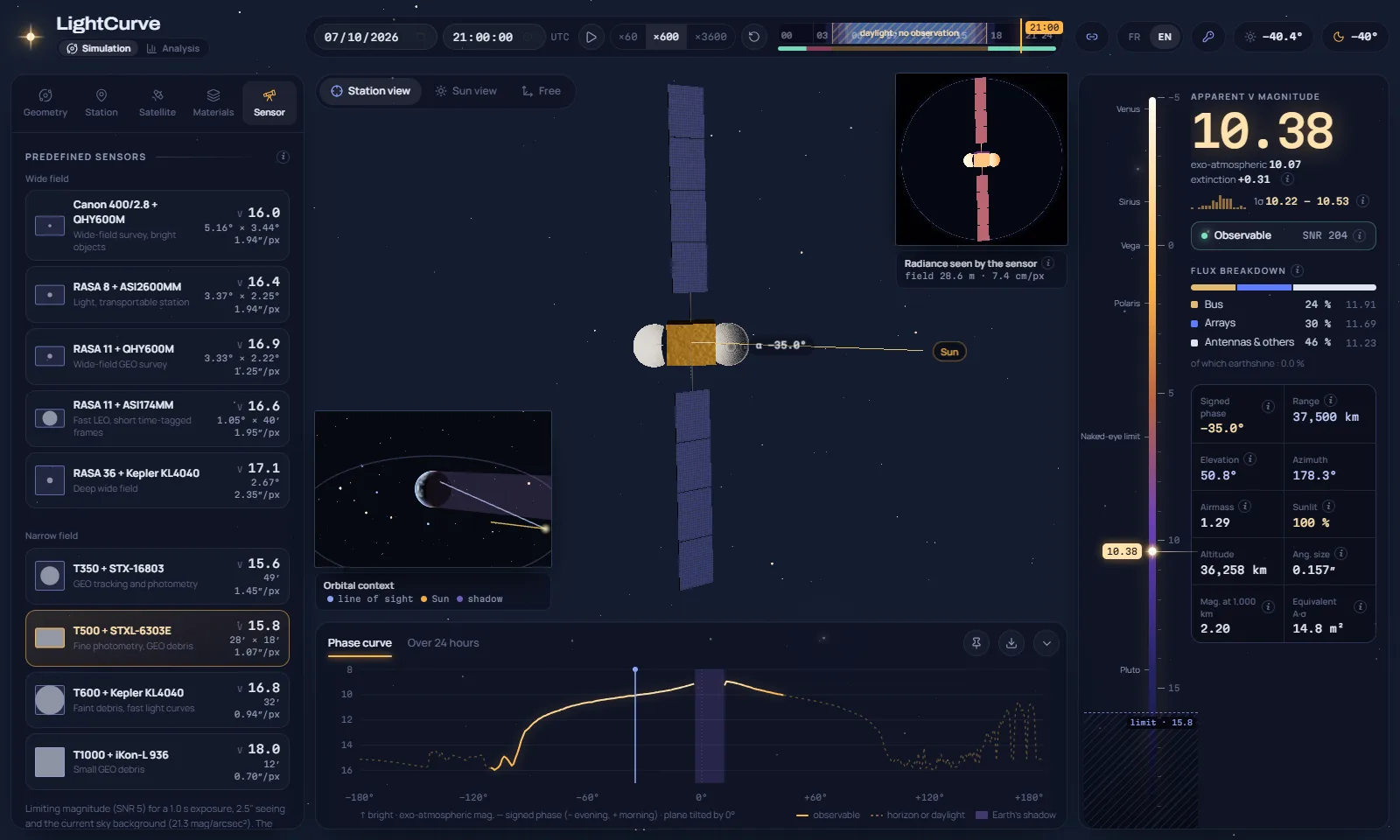
Large constellations are judged on how bright they look from observatories. Answering early — while materials and attitude can still change — takes a physical model, not a rule of thumb.
Step by step.
- 01
Model the spacecraft
Start from a broadband-constellation preset or your own CAD, in its operational attitude with Sun-tracking arrays.
- 02
Sweep the geometry
Phase curve, 24-hour curve from a given observatory, real passes from a TLE, observable windows with twilight constraints.
- 03
Test the mitigations
Darker materials, another attitude, another array angle: compare against a pinned reference curve and read the change per material.
- 04
Bound the answer
A Monte-Carlo interval (68 %) over albedos, specular reflectance, attitude and extinction. Whole parameter grids in batch mode.
Deliverables.
- Magnitude along passes and across the sky
- What-if comparisons against a reference design
- Uncertainty interval on every figure
- Batch results as CSV for reporting
Predict, then explain, the brightness of your satellite
From design review to anomaly investigation: how bright your spacecraft looks, where its glints come from, and what a change in its light curve means.
See the use caseMake satellite photometry visible
See why a satellite brightens or fades — phase angle, glint, shadow, attitude — live and in 3D, with physics you can check.
See the use caseSize a sensor network before you buy it
SNR, limiting magnitude and saturation of real telescope and camera combinations, against the objects you must see — from the ground or from orbit.
See the use caseSee your own objects in LightCurve.
A 30-minute session on your use case: your orbits, your sensors, your measurements if you have them.