Know the tumble before the rendezvous
Estimate a target’s spin period, its axis and how they evolve, from ground photometry — to plan the approach and the capture of a non-cooperative object.
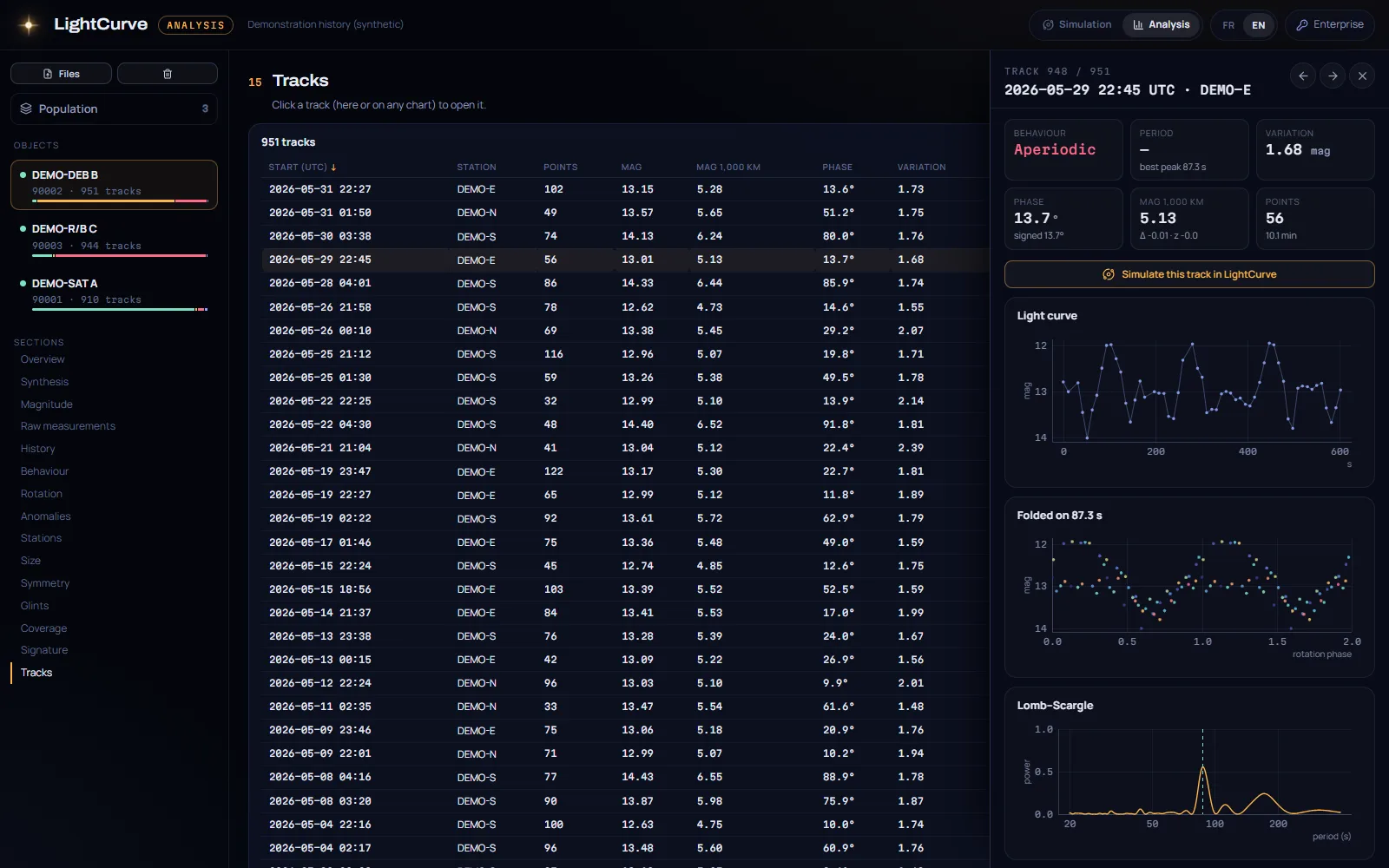
A defunct satellite or a spent upper stage does not report its attitude. A servicer needs to know how it tumbles — period, axis, stability — long before getting close.
Step by step.
- 01
Simulate free tumbling
Euler’s equations with the inertia tensor: the spin axis precesses and nutates. Upper-stage models such as Falcon 9, SL-16, Ariane 5 ESC-A and Centaur are included.
- 02
Find the period
Periodogram and folding on each night, keeping the full turn of elongated bodies that show two maxima per rotation.
- 03
Fit the motion
Spin period, axis and rotation phase fitted jointly to several nights and stations.
- 04
Follow it over months
With the Analysis workspace: spin-down rate, abrupt changes and their dates, from the whole history of the target.
Deliverables.
- Spin period with its 1σ uncertainty
- Spin-axis and attitude candidates
- Spin-rate trend and change dates
Characterise objects from their light curves
Turn magnitudes into answers: is it stabilised, spinning or tumbling, how fast, how big — and does a physical model explain what your sensors measured?
See the use caseWatch a whole catalogue for behaviour changes
Months of tracks from many stations, turned into a report per object — behaviour, rotation trend, glints — and alerts the day something changes.
See the use caseTrain classifiers on labelled light curves
Physically rendered, perfectly labelled synthetic light curves — shape, attitude state, period, axis, geometry, sensor noise — by the thousand.
See the use caseSee your own objects in LightCurve.
A 30-minute session on your use case: your orbits, your sensors, your measurements if you have them.