Train classifiers on labelled light curves
Physically rendered, perfectly labelled synthetic light curves — shape, attitude state, period, axis, geometry, sensor noise — by the thousand.
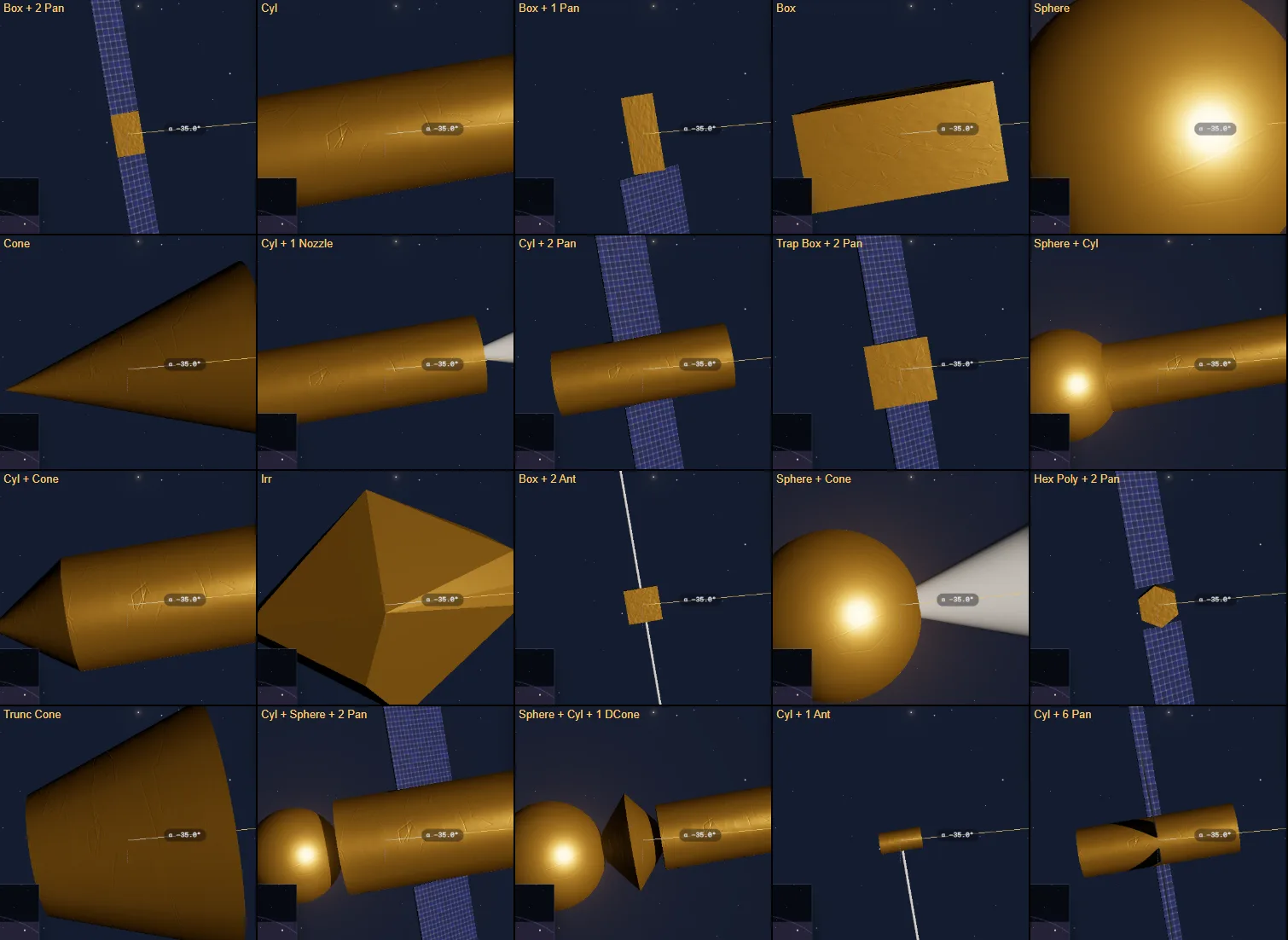
Real light curves come with few labels and many biases. A classifier needs examples where the truth is known — and enough of them.
Step by step.
- 01
Describe the population
Models and DISCOS shapes, attitude states, periods, spin axes, inertia, geometries and sensor noise, drawn from the ranges you choose.
- 02
Render it on the GPU
The same photometric engine as the simulator, from the interface or from the command line, with a fixed seed for reproducibility.
- 03
Close the loop on real data
Check the classifier against measured tracks with the built-in attitude-state classification and the model fit.
Deliverables.
- Labelled datasets in CSV
- Batch mode and JavaScript API
- Reproducible runs
Characterise objects from their light curves
Turn magnitudes into answers: is it stabilised, spinning or tumbling, how fast, how big — and does a physical model explain what your sensors measured?
See the use caseKnow the tumble before the rendezvous
Estimate a target’s spin period, its axis and how they evolve, from ground photometry — to plan the approach and the capture of a non-cooperative object.
See the use caseMake satellite photometry visible
See why a satellite brightens or fades — phase angle, glint, shadow, attitude — live and in 3D, with physics you can check.
See the use caseSee your own objects in LightCurve.
A 30-minute session on your use case: your orbits, your sensors, your measurements if you have them.